Summary
I’m proud to announce Sarah Margolis-Greenbaum is the new Head of Accessibility at Intuit. We’ve been working on this transition for a few years and she’s going to take the team to amazing new directions. I will be shifting to Intuit Design System and other projects.
I’m happy to announce Sarah Margolis-Greenbaum is the new Head of Accessibility at Intuit.
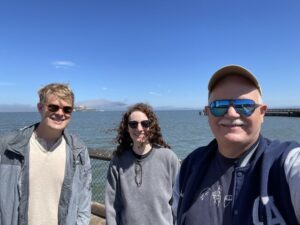
For people who know me primarily through accessibility, this may come as a surprise. I’ve been honored to lead accessibility at Intuit for 15 years. But this isn’t a sudden change. Sarah and I have been planning this transition for two years, and she led the accessibility team for the first half of our last fiscal year while I focused on another project.
It was important to me for this transition to be deliberate. Accessibility programs shouldn’t depend on one person staying in the same job forever. If we’re serious about building sustainable programs, we also need to create space for new leaders to take them somewhere we couldn’t.
With Sarah leading accessibility and Ken Bigler leading accessibility engineering, I’m excited about what comes next.
Sarah’s Journey at Intuit
Sarah joined Intuit in 2017 as an intern researching the barriers and opportunities Deaf entrepreneurs and accountants experience when using financial products.
Her role kept growing.
Over the years, Sarah has led or contributed to work involving live captioning for company events, accessibility requirements in our Supplier Code of Conduct, a centralized accommodation budget, accessibility policies and standards, and Intuit’s Accessibility and Inclusive Design Guidelines.
She has also managed more than 100 customer research sessions with disabled customers.
This is one of the things I appreciate most about Sarah’s approach. Accessibility isn’t simply a collection of standards and compliance requirements. The work has to stay connected to people using our products.
Sarah and I have been working together on this broader approach for a long time. In 2018, we presented Trickle Down Accessibility at the CSUN Assistive Technology Conference. The premise was simple: expand how we think about disability, listen to more communities, and use what we learn to build better products.
More recently, Sarah has been helping us rethink how AI can change accessibility work.
She built Meridian, an internal accessibility compliance tool combining screen reader, keyboard, and visual emulation. The goal is to automate much of the repetitive work involved in accessibility audits while keeping people involved in reviewing the results and making decisions.
Work that once took months can increasingly happen alongside product development.
Sarah is also exploring AI-assisted approaches to document remediation and has managed the development of our updated online accessibility education.
But the interesting part isn’t simply using AI.
It’s what we can do with the time we get back.
If we spend less time doing repetitive manual work, accessibility teams can spend more time working with customers, designers, engineers, researchers, and product teams. Automation should create more room for human connection, not less.
I’ve been exploring this same idea in my work on building trusted accessibility AI. The technology is useful when it scales knowledge and removes repetitive work. It shouldn’t replace the lived experience, judgment, and relationships accessibility depends on.
Accessibility and Design Systems
My own role is changing as well.
I’m moving into leadership of the Intuit Design System and Inclusive Design organization, inheriting a strong foundation built by Andrea Turner, Kristen Treacy, and many others across Intuit.
A design system can do much more than create consistency. It can move accessibility upstream.
Instead of finding the same accessibility problem in dozens of products and asking dozens of teams to fix it, we can address more of those decisions in the components, patterns, guidance, and tools teams use to build products in the first place.
We’re also thinking beyond traditional accessibility requirements. Inclusive interaction design needs to consider cognitive energy, memory, attention, and the many different ways people perceive and interact with technology.
Bringing accessibility and design systems closer together gives us another opportunity to experiment with how this works at scale.
Fifteen Years Is a Long Time
When I joined Intuit, Cheryl Ainoa gave me an unusually broad assignment: do whatever needs to be done to make Intuit accessible.
There wasn’t a playbook.
Fifteen years ago, many of our web applications had little keyboard accessibility. Desktop software often didn’t work well with assistive technology. Color choices created barriers. Workplace accommodations could be difficult to navigate. Conversations about neurodiversity, intersectionality, and inclusive design were nowhere near where they are today.
The accessibility work also exposed a larger problem.
People were often working in silos.
One of my first responses was creating a Front End Engineering Summit to bring developers together around shared problems, code, and recognition. Later came disability ERGs, Accessibility Champions, Lunch and Learns, training programs, and many other ways for people to learn from each other.
More than 5,000 people have participated in our accessibility Lunch and Learns. We set an annual goal for 20% of employees to participate in some form of accessibility education.
Accessibility stopped being something a small accessibility team could own. It became something thousands of people could participate in.
This has probably been the most important lesson from my 15 years leading accessibility at Intuit. You can build standards. You can build tools. You can write policies. You can run audits.
But accessibility becomes durable when you build a community around it.
Making Room for What Comes Next
Leadership transitions are part of building a healthy community.
If a program falls apart when its founder or longtime leader moves on, it probably wasn’t as mature as everyone thought.
My job wasn’t to make myself indispensable. It was to help build an accessibility program capable of continuing to grow without me at the center of it.
I’ve written before about moving accessibility leadership from “I” to “we”. Accessibility becomes stronger when knowledge, authority, and opportunities are shared. People need room to step forward, experiment, and eventually lead in ways we may not have anticipated.
Sarah brings different strengths, experiences, and ideas to this work. She has an extraordinary eye for detail, embraces experimentation with AI, and keeps lived experience close to the decisions we make.
She’ll do things differently than I did.
She should.
I’m not leaving accessibility behind. I’ll still be working closely with Sarah, Ken, and the accessibility community while putting more of my attention into design systems and inclusive design.
But Sarah is leading accessibility now.
After 15 years, I’m incredibly proud to pass her the torch. And I’m even more interested in seeing where she takes it.
AI Disclosure: This post was written with AI assistance for brevity