

Summary
Accessibility work often begins with urgency, but lasting change requires structure. This article explains how maturity models help organizations build accessibility over time instead of relying on one-off fixes or a few experts.
It introduces the Disability Accessibility Maturity Model (DAMM), which shows how accessibility grows from reactive work to shared, repeatable practices embedded in everyday decisions. The focus is not perfection, but progress.
The article also explains how to use DAMM in a practical way: understand current behavior, fix points of friction, make small improvements, and revisit progress regularly. Maturity models provide a clear path toward accessibility that is reliable, shared, and sustainable.
Accessibility work often starts with urgency. A customer complaint, a legal requirement, a failed audit, or a team member raising their hand and saying, “This isn’t working for everyone.” Those moments matter, but urgency alone doesn’t create durable change. What sustains accessibility over time is structure, shared understanding, and a clear sense of progression. This is where maturity models become useful—not as scorecards, but as maps.
A maturity model helps organizations understand where they are today, what “better” actually looks like, and which steps matter most right now. When used well, it replaces vague aspirations with practical direction.
What Maturity Models Are (and Are Not)
Across disciplines—software engineering, security, design operations, organizational change—maturity models follow a similar pattern. Research into models like CMMI, DevOps maturity frameworks, and design maturity models shows three consistent traits:
- Progression over perfection. Mature systems are built iteratively, not all at once.
- Behavior over policy. Real maturity shows up in day-to-day decisions, not just documentation.
- Integration over specialization. As maturity increases, responsibility spreads beyond experts and into shared practice.
What maturity models are not is compliance checklists or ranking systems. When organizations treat them as grading tools, teams optimize for appearances instead of outcomes. The goal is not to “reach the top,” but to move forward deliberately.
Why Accessibility Needs Its Own Model
Accessibility maturity models must account for something many other models do not: lived experience. Accessibility is not just technical correctness. It intersects with disability, cognition, stress, time pressure, and human variability. That means progress is as much cultural as it is procedural.
This is where the Disability Accessibility Maturity Model (DAMM) becomes useful. DAMM is designed specifically to help organizations understand how accessibility grows from awareness into embedded capability, without assuming unlimited resources or centralized control.
At Intuit, we started with our own maturity model that was based on questions from project managers. They were looking for the steps needed to ensure they were building accessible products. We switched to the DAMM after a few years, as it was much more comprehensive. In particular, it pointed out our lack of resourcing for procurement policies and internal tools. This led us to bring on a new member to our team to focus on this.
There are many maturity models, it’s important to look at how they align with your companies products, services, and structure.
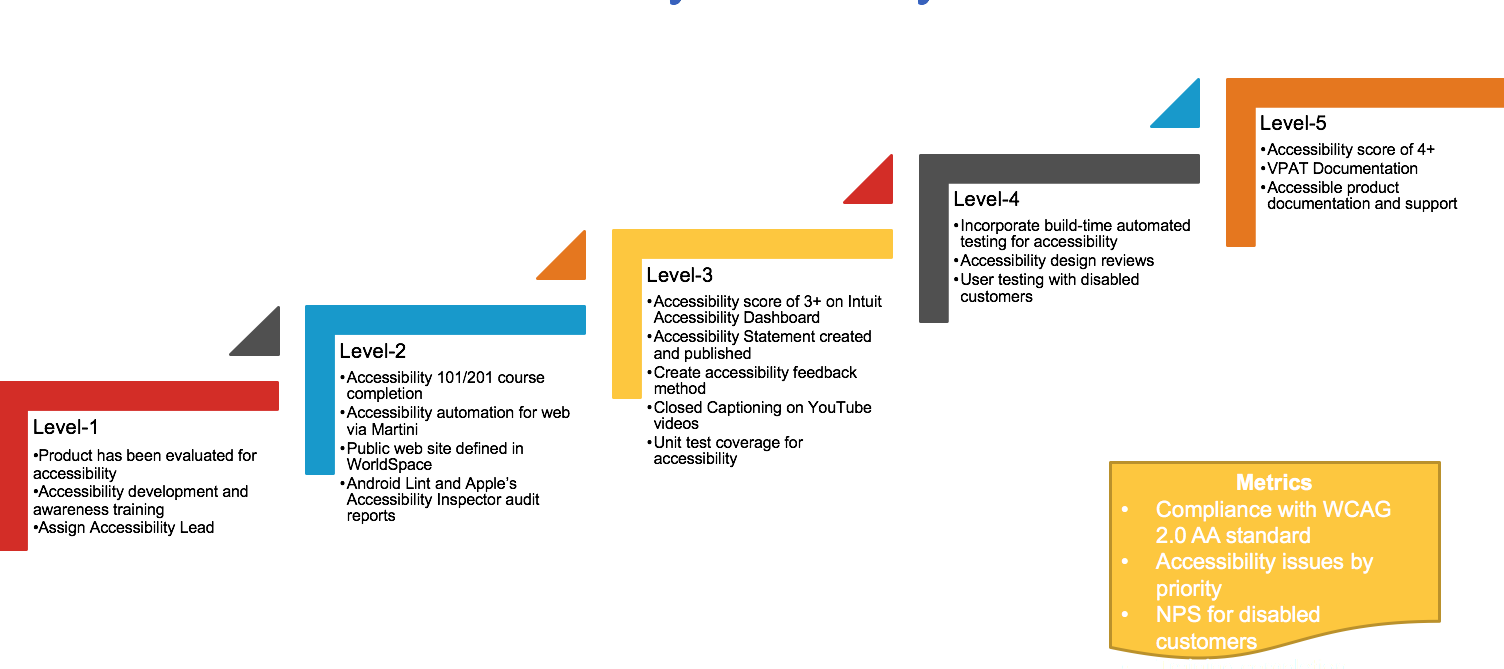
The DAMM Stages, Practically Applied
While the DAMM can be represented visually, it is most helpful when translated into observable behaviors.
Early stages focus on awareness and reaction.
Accessibility exists, but inconsistently. Knowledge lives with a few individuals. Work is often triggered by audits, bugs, or escalation. If you ask teams how accessibility fits into their process, you will hear different answers—or none at all.
Mid stages emphasize repeatability and shared language.
Teams begin documenting expectations. Training expands beyond specialists. Accessibility appears in planning conversations, not just testing phases. This is often where organizations introduce champion programs, office hours, or internal guidance hubs. Progress here is fragile but meaningful.
Later stages reflect integration and ownership.
Accessibility is no longer something teams “remember to do.” It is embedded in design systems, development workflows, procurement, and metrics. Decisions account for disabled users even when no one in the room identifies as an expert. Importantly, the organization can sustain accessibility through change—reorgs, new leadership, new tools.
The DAMM does not assume linear movement or uniform adoption. Different teams may sit at different stages, and that is expected.
How to Use DAMM as a How-To Tool
A maturity model only helps if it changes behavior. Here is how organizations can use DAMM pragmatically.
Start with honest self-assessment.
Instead of asking “What stage are we?” ask “What do we actually do today?” Look for evidence: onboarding materials, design reviews, backlog practices, support processes. Avoid aspirational answers.
Identify friction, not gaps.
Research on maturity adoption shows that organizations stall when they chase missing artifacts instead of addressing friction points. Ask where accessibility slows teams down, gets dropped, or creates anxiety. Those moments reveal what to improve next.
Choose one stage-appropriate investment.
DAMM works best when paired with small, deliberate actions. That might be adding accessibility criteria to intake forms, documenting common questions instead of answering them repeatedly, or shifting from ad-hoc reviews to scheduled check-ins. Resist the urge to do everything at once.
Use the model to explain “why now.”
Maturity models are powerful communication tools. They help leaders understand why a proposed investment makes sense at this moment—not because it is trendy, but because it aligns with where the organization already is.
Revisit regularly.
Research on organizational maturity consistently shows that progress is non-linear. Teams advance, regress, and adapt. Treat DAMM as a living reference, not a one-time assessment.
The Real Value of Maturity Models
The most important insight from studying maturity models is this: maturity is not about sophistication. It is about reliability. When accessibility becomes reliable—predictable, repeatable, shared—it stops depending on heroics.
DAMM helps organizations move from good intentions to durable systems. Not by prescribing a single right way, but by making progress visible, discussable, and achievable.
Accessibility that lasts is not built in leaps. It is built in stages, with care, clarity, and the humility to meet teams where they are.
Additional information on maturity models
- An Introduction to the Digital Accessibility Maturity Model (DAMM)
A clear overview of DAMM, including its stages, dimensions, and how organizations can use it to structure long-term accessibility efforts. - Digital Accessibility Maturity Model Toolkit (AbilityNet)
Practical resources, worksheets, and guidance for applying DAMM in real organizations, with an emphasis on incremental improvement. - Accessibility Maturity Model (Draft) – W3C
The W3C’s draft accessibility maturity model, including discussion of how different models relate and how maturity can be assessed across organizational functions. - Comparison of Accessibility Maturity Models
A side-by-side comparison of DAMM, the W3C model, Microsoft’s Accessibility Evolution Model, and others—useful for understanding common patterns and differences. - How to Measure the Accessibility Maturity of Organizations
An academic literature review identifying dozens of accessibility maturity models and the indicators most commonly used to assess organizational progress. - DAMM Overview and Key Components
An accessible, plain-language explanation of DAMM and how it supports sustainable accessibility practices.