Summary
CSUN 2026 showed accessibility is bigger than compliance. Strong sessions connected AI, mobility, navigation, product design, policy, and lived experience across a broad disability spectrum.
At the CSUN Assistive Technology Conference 2026, I found myself drawn to sessions that widened the frame.
Not just sessions about websites, audits, or checklists. Not just sessions about whether something passed or failed. I was most interested in the work that treated disability as broad, lived, and interconnected. The sessions that looked at mobility, communication, policy, culture, product design, navigation, and human judgment. The ones that understood accessibility as part of daily life.
That broader view matters. Disability is not one experience. Inclusive design is not one discipline. And if we want accessibility to scale, we need to keep stretching beyond the familiar lanes of digital compliance and into the fuller reality of how people move, communicate, work, learn, shop, navigate, and participate.
This year, a number of sessions did exactly that.
AI as a tool, not a substitute for people
One of the clearest examples came from Intuit’s session, Using AI to Reframe Digital Communication. What I appreciated most was that it did not fall into the usual trap of treating AI as either magical or dangerous in the abstract. It showed how AI can be used to coach people to understand the context and purpose of communications. AI isn’t replacing people’s power, rather supporting their needs.
That distinction matters.
Human Powered Digital Accessibility in an AI World laid it out plainly: AI can help with speed, scale, round-the-clock availability, cost reduction, and pattern recognition. Those are real strengths. But another slide made the limits just as clear. AI misses cultural nuance. It makes mistakes in specialized content. It cannot bring empathy or contextual judgment. Human ASL signers are still preferred. Audio description still requires narrative craft.
That was one of the most grounded messages I heard at the conference. The best use of AI in accessibility is not replacing people. It is supporting people. It is helping teams move faster while still relying on human expertise for meaning, tone, trust, and care.
That message also connects to a broader disability perspective. Communication access is not simply about generating words. It is about making sure those words land correctly for real people in real situations. That includes culture, disability, stress, language, lived experience, and domain knowledge. Accessibility breaks down quickly when those layers are treated as optional.
The strongest framing from that session could be summed up in one idea: human-powered accuracy, AI-assisted efficiency. That feels like a much healthier direction than the usual rush toward automation for its own sake.
Mobility, autonomy, and assisted independence
Another session that expanded the conversation was the presentation from Christian Mandel of DFKI on smart wheelchairs and assisted navigation.
I appreciated this session because it pushed accessibility into a space that often gets less attention in mainstream design conversations. Too often, accessibility discussions stay centered on screens and software. This session reminded the room that mobility systems, interfaces, safety logic, hardware, and autonomy all belong in the conversation too.
The slides showed a sophisticated view of wheelchair support. There were hardware components like RGBD cameras, lidar, odometry systems, onboard computer, and emergency stop controls. There were driving assistance systems designed to help users navigate safely without removing their agency. But still required the user to maintain control of the chair’s actions.
That balance stood out to me. The work was not presented as “let the machine take over.” It was presented as assistance layered around the user. A baseline driving assistant safeguarded commands, checked for obstacles in real time, and helped steer or stop when needed. That is a very different philosophy from full handoff. It is a design model based on support, not displacement.
The user experience findings were also important. Participants rated the system positively across many dimensions, but they also raised concerns. Some felt the wheelchair movement was too slow. Some felt the solution looked outdated. Some felt crowded spaces made navigation harder.
That matters because accessibility is never only technical. Trust, dignity, aesthetics, confidence, and social context all shape whether a solution feels usable. A technically capable system that feels awkward, slow, or socially uncomfortable can still fail the person using it.
This session was a strong reminder that inclusive design has to account for embodiment. Not everyone interacts through a keyboard, touchscreen, or browser. Some people interact through mobility devices, voice systems, navigation aids, and safety interfaces. Accessibility gets better when we keep widening our definition of interface.
Inclusive design is moving into mainstream product strategy
One of the more interesting signals at CSUN this year was seeing accessibility framed through the language of product innovation, not just compliance or accommodation. A Nike session, Ignite a New Era: Universal Product Design, captured that shift especially well.
The details on stage mattered less to me than the framing itself. Here was a major global brand talking about universal product design as a future-facing strategy. Not as a side project. Not as a special collection tucked away from the main business. But as design thinking that can shape the next era of product development.
That is a meaningful shift.
When accessibility enters mainstream product design conversations, the conversation changes. It stops being limited to whether a product can be used after the fact. It becomes a question of who is imagined from the beginning. It becomes a question of who gets treated as central to innovation.
That is one of the reasons inclusive design matters so much. It does not just patch exclusion. It creates better starting assumptions.
Sessions like this help expand the field. They remind us that inclusive design belongs in footwear, apparel, consumer products, industrial design, physical environments, and brand strategy. The disability community has always generated insight that reaches far beyond any single category. More companies are finally starting to recognize that.
Navigation, perception, and the real world
Another promising thread came from sessions focused on blind and low-vision navigation, including a presentation framed around Seeing the World and another titled AI for Accessibility: Real-World Innovations Empowering People with Disabilities.
These sessions stood out because they stayed anchored in practical use. The focus was not AI in the abstract. It was what AI can actually do to support orientation, mobility, perception, and environmental awareness for blind and low-vision users.
That practical orientation is important. There is no shortage of accessibility hype right now. But when presenters are talking about improving navigation in the real world, the conversation becomes more grounded. Now the questions are different. Does this reduce friction? Does it improve confidence? Does it help someone move through unfamiliar spaces more independently? Does it work under pressure?
Those are the questions that matter.

On the expo floor, I also saw a tactile map being explored by Stevie Wonder, who visits CSUN each year to experience the latest assistive technology. That moment stayed with me. It was easy to read it as a reminder that tactile access, orientation, and physical interaction still matter deeply. Not every breakthrough is a software feature. Sometimes it is a better way to understand a space, feel a system, or navigate with greater confidence.
That is part of the broader spectrum too. Accessibility is visual, tactile, auditory, spatial, cognitive, emotional, and social. We lose something when we flatten it into only one mode of interaction.
The global accessibility story is getting bigger
Some of the most useful sessions I attended were not about products at all. They were about policy, standards, and how accessibility is developing across regions.
Building bridges between Africa and Europe highlighted what makes the EU model distinct. The framing was that Europe regulates accessibility primarily through standards and market access. The European Accessibility Act, harmonized standards, and cross-border conformity were all part of that discussion. Specific standards like EN 301 549, EN 17161, and EN 17210 illustrated how digital accessibility, Design for All, and the built environment are being tied together in a more systemic way.
That is a significant shift for anyone working in accessibility leadership. Accessibility is no longer only a local compliance concern. It is becoming a market expectation, a procurement issue, and a cross-border operational reality.
What made the session stronger, though, was that it did not stop with Europe. It also looked at South Africa, Kenya, and African regional law. Slides referenced the Constitution of South Africa, PEPUDA, the Convention on the Rights of Persons with Disabilities, the Electronic Communications Act, Kenya’s legal and policy developments, and the African Disability Protocol.
That broader view mattered.
Too often, accessibility conversations get trapped in a small set of geographies and legal frameworks. These sessions helped show that disability rights and accessibility policy are evolving in many regions, each shaped by its own social, economic, and political context. The result is not one universal model copied everywhere. It is a growing ecosystem of approaches that share values while responding to local realities.
That is a healthier way to think about global inclusion. Not sameness, but alignment with context.
The conference is also about relationships
One of the reasons CSUN continues to matter is that the learning does not end when the slide deck does.

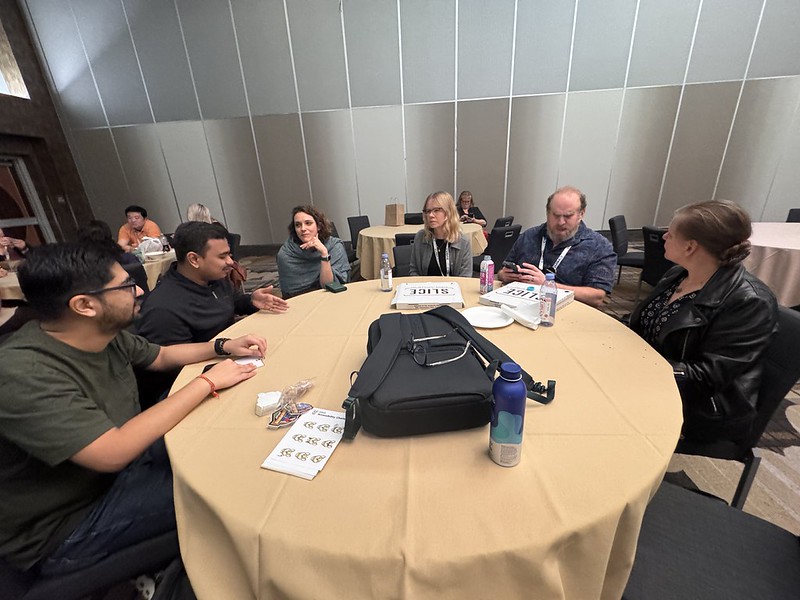
Some of the most meaningful moments came in conversations around tables, in booths, and in those quick discussions that happen before or after a session. I saw small group conversations over pizza. I saw demos in progress. I saw exhibitors showing tactile tools, safety devices, and enterprise platforms. I saw people comparing notes across disciplines that do not always talk to each other enough.
That ecosystem matters.
Accessibility is not advanced by presentations alone. It moves because people bring research into practice, policy into product design, lived experience into engineering, and community into leadership. CSUN is still one of the few places where all of those threads can be seen in the same few days.
That is part of what made this year’s broader-spectrum sessions so valuable. They did not treat disability as narrow or isolated. They showed how much there is to learn when we connect the dots between digital communication, mobility, navigation, product design, law, and lived experience.
The larger lesson
If there was one lesson I kept coming back to at CSUN 2026, it was this: accessibility gets stronger when we resist the urge to shrink it.
When we reduce it to compliance alone, we miss design. When we reduce it to digital alone, we miss mobility and space. When we reduce it to technology alone, we miss judgment and culture. When we reduce it to one disability experience, we miss the broader spectrum of human variation.
The sessions that stayed with me were the ones that refused that narrowing. They embraced complexity. They recognized multiple forms of disability. They treated inclusive design as something that belongs across products, systems, environments, and policies. And they made room for the idea that accessibility is not a specialty sitting off to the side. It is part of how better experiences are made.
That is the direction I hope more of us keep pushing.
Because the future of accessibility will not be built by staying in one lane. It will be built by seeing the whole landscape more clearly, and by designing with a wider understanding of who has always been here.
This post was written with AI assistance to parse my notes and saved presentations to create connections.